Calculate car loan repayments with our Car Loan Repayment Calculator. View detailed amortization charts to compare terms, track interest, and plan your budget with confidence.
Calculator results are estimates based on the inputs and assumptions used and are provided for general information only. They are not quotes, offers, approvals, eligibility decisions or personalised recommendations. Actual costs and repayments may differ.
Car Loan Details:
Important!
Car Loan Interest Rates differ from lender to lender and will depend on your individual circumstances (credit history, employment status, age, etc.).
Car Loan Amortisation Calculator
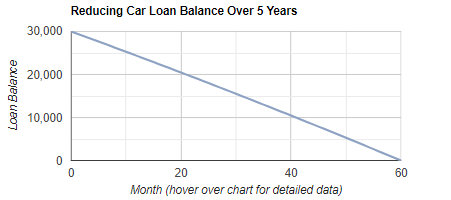
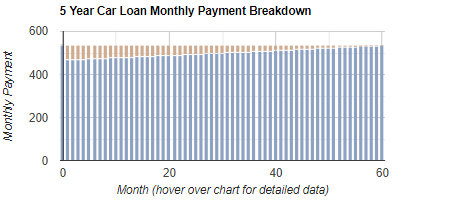
The following amortisation graphs detail month-by-month data on the progress of the proposed loan. The first chart below examines the reducing loan balance over the course of the finance contract term. The second graph illustrates the portion of each monthly repayment allocated to payment of interest vs principal reduction.
How to use our Car Loan Repayment Calculator
Our Car Loan Repayment Calculator helps you estimate repayments for an Australian car loan and see how your balance, interest and principal change over time. It is important because small changes to the loan amount, term or interest rate can materially affect your monthly budget and the total interest you pay. The amortisation charts make it easier to compare scenarios and choose a structure you can afford with confidence.
General information only: This calculator provides an estimate and does not take into account your objectives, financial situation or needs. Results are indicative and your actual interest rate and repayments will depend on the lender, your credit profile and the final loan contract (including fees and conditions).
How to complete each section for the best result:
1. Purchase Price
Enter the vehicle purchase price as a whole number (no decimals or commas). If you plan to borrow extra for on-road costs such as stamp duty, registration or insurance, include those amounts here so the estimate better reflects your likely loan size.
2. Deposit or Trade-in Value
Enter your cash deposit and/or trade-in value as a whole number. A higher deposit reduces the amount financed and usually lowers repayments and total interest.
3. Term of Loan (Years)
Select the number of years you want to repay the loan over. Shorter terms usually mean higher repayments but lower total interest. Longer terms can reduce monthly repayments but typically increase total interest paid.
4. Interest Rate (% per annum)
Select an interest rate to simulate. If you have a quote, choose the closest rate. If comparing options, run multiple calculations to see the impact of different rates.
5. Calculate
Click calculate to generate your results and charts.
How to interpret the results:
1. Repayment estimate: Use this as a starting point for affordability, leaving buffer for running costs and rate changes.
2. Amortisation charts: One chart shows the loan balance reducing over time; the other shows how early repayments are often interest-heavy and gradually shift toward principal repayment.
3. Comparison planning: Re-run the calculator with different terms, deposits and rates to identify a repayment level and total interest outcome that suits your budget.
In the dynamic world of Australian finance, securing a loan can be a pivotal move for individuals seeking to achieve their financial goals. Whether it's for purchasing a dream home, expanding a business, or simply consolidating debt, the importance of smart loan comparison cannot be overstated. With an array of lending products available, borrowers are often faced with a bewildering choice. That's why equipping yourself with powerful loan comparison strategies is not just important, it's essential. - read more
Welcome, Australian entrepreneurs and business owners! Whether you're just setting down the foundation of a startup or steering a well-established enterprise, access to capital remains a critical ingredient for business growth and survival. In the bustling economy of Australia, a well-structured business loan can be the catalyst that propels your business forward, aiding in expansion, the acquisition of new equipment, or simply ensuring smooth operational cash flow during lean periods. - read more
In recent years, refinancing has emerged as a popular financial strategy for many Australian homeowners. With the housing market's dynamic nature and fluctuating interest rates, more people are considering the benefits of refinancing their home loans. This trend is not surprising, as refinancing can potentially reduce monthly payments, secure lower interest rates, and assist with debt consolidation. - read more
APRA’s latest banking indicators point to a lending market that is still open, but not loose. Mortgage credit continues to move through the system, yet the regulator’s focus on serviceability, risk controls and higher-risk lending means borrowers should expect applications to be examined carefully rather than waved through on headline income alone. - read more
Australia’s latest national accounts have given borrowers a fresh read on the economy: growth is continuing, but momentum remains uneven and household spending is still being tested by higher living costs. For anyone weighing up a personal loan, home loan refinance, vehicle finance or business funding, the message is less about one headline number and more about how stable income, expenses and cash flow look over the next year. - read more
Fresh lending and banking indicators are giving Australian borrowers a timely reminder: the headline interest rate is only one part of the finance decision. While some lenders have been adjusting selected offers and competition remains visible in parts of the market, arrears and repayment stress are still important signals for households and small to medium-sized businesses planning their next move. - read more
Foreclosure: The legal process by which a lender takes control of a property, evicts the homeowner, and sells the home after the homeowner fails to make mortgage payments.